Wednesday, 10 October 2012

Tenant seeks to overturn VCAT's exclusive jurisidiction

Please note for members of the public or practitioners in the legal profession where English is your second language a translation key in all languages of the world is available on this blog to assist you. The plain English blog without translation facilities is located at http://roberthaypropertybarrister.wordpress.com


In Ireland v Subway Systems Australia Pty Ltd and Subway Realty Pty Ltd [2012] VCAT 1061 a tenant contended if an agreement (which it contended was a licence) was held to be a lease then the dispute had to be determined by an arbitrator pursuant to an arbitration clause and not by VCAT.  The arbitration clause was contained in the a document separate from the lease.

VCAT held that the agreement was a lease and therefore there was a "retail tenancy dispute" which, subject to the tenant's argument about the Commercial Arbitration Act, would be governed by the dispute provisions of the RLA. If the tenant's application had succeeded the whole regime of the dispute resolutions provisions in the RLA would have been displaced. The tenant argued that the arbitration clause should be given effect to because s 10 of the Commercial Arbitration Act 2011 was pronounced after the commencement of the 2003 Act and, by implication, repealed the provisions of the RLA that gave exclusive jurisdiction  concerning retail tenancy disputes to VCAT.  

The tenant contended that the word “court”  in s 10 of the Commercial Arbitration Act included the Tribunal. At [45] the Tribunal accepted that there was authority supporting the proposition that, in some cases, the reference to a “court” will include the Tribunal. The tenant contended that to construe the word “court” in the Commercial Arbitration Act to include the Tribunal would not create inconsistency between that Act and the RLA because the Commercial Arbitration Act was a later Act of Parliament which would, by implication repeal the inconsistent provisions of the RLA.  In rejecting the tenant’s contentions the Tribunal said:
 [50]       I do not accept that submission. In Goodwin v Phillips (1908) 7 CLR 1 at 10, Barton J adopted the following statement from Hardcastle on Statutory Law:

The court must be satisfied that the two enactments are so inconsistent or repugnant that they cannot stand together, before they can from the language of the later imply the repeal of an express prior enactment, i.e., the repeal must, if not express flow from the necessary implication.

[51]       Further, in Saraswati v R (1991) 100 ALR 193 Gaudron J stated the following;

It is a basic rule of construction that, in the absence of express words, an earlier statutory provision is not repealed, altered or derogated from by a later provision unless an intention to that effect is necessarily to be implied. There must be very strong grounds to support the implication, for there is a general presumption that the legislature intended that both provisions should operate and that, to the extent that they would otherwise overlap, one should be read as subject to the other (at 204)

[53]         In my view, limiting the word court in s 10 of the Commercial Arbitration Act 2011 to mean the Magistrates’ Court, County Court or Supreme Court would not lead to any inconsistency between the two Acts and is a construction that is to be adopted, having regard to the authorities cited above. Accordingly, I do not accept the submission that the word court in the Commercial Arbitration Act 2011 includes the Tribunal. It simply cannot be the case that Parliament intended that the Commercial Arbitration Act 2011 and the RLA were to cover the same field of operation. The RLA is expressed elaborately and specifically details how retail tenancy disputes are to be resolved. The Commercial Arbitration Act 2011 says nothing about resolving retail tenancy disputes and is expressed in a general manner. In my view, that is another factor weighing against a finding that Parliament intended the provisions of the Commercial Arbitration Act 2011 to take precedence over the dispute resolution provisions of the RLA. Accordingly, I find that the word court in the Commercial Arbitration Act 2011 does not include the Tribunal and as a consequence, the Commercial Arbitration Act 2011 has no application in determining the present dispute.

My clerk can be contacted via this link http://www.greenslist.com.au/ if you wish to retain my services for any legal matter which is within the gamut of my legal experience.

 Author: Robert Hays Barrister subject to copyright under DMCA.

Wednesday, 5 September 2012

The Mortgagee's Power Sale out soon


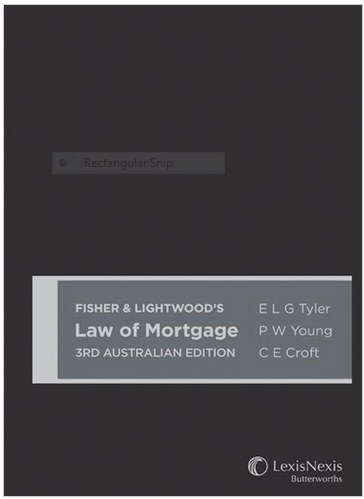
Some of my readers have suggested that this blog has quiet of late. The reason is that I have had a deadline to complete the new book which I had to the privilege to work with two brilliant legal minds who were co-authors - and we have been collaborating to  finish the 3rd Edition of   The Mortgagee's Power of Sale.   

Clyde Croft (now The Honourable Justice Croft) wrote the first edition, was co-author of the second edition and is co-author of the 3rd edition. T

he Mortgagee’s Power of Sale will provide an up-to-date,  practical guide to the steps that a mortgagee must take to obtain possession of and sell land and a detailed analysis of a mortgagee’s duty in selling land.

Registered and unregistered mortgages are considered together with the different issues that arise when considering Torrens system and general land.

There is also a comprehensive discussion about a mortgagor’s rights including the lodging of caveats and obtaining an injunction t0 prevent a sale. W

hile maintaining its practical emphasis the book considers recent significant decisions such as Bofinger  v Kingsway Group, MBF v Nolan Ltd and Residential Housing Corporation v Esber.   The book is likely to  be published in late November the launch in January 2013.

Ecommerce is available from Lexis Nexis via this Link   http://www.lexisnexis.com/en-us/about-us/about-us.page


My clerk can be contacted via this link http://www.greenslist.com.au/ if you wish to retain my services for any legal matter which is within the gamut of my legal experience. 


Friday, 31 August 2012

Can a landlord pass to the tenant the costs of complying with theBuilding Act?


I recently presented a short paper at the Law Institute of Victoria's Property Law Conference on the topical question of  whether a landlord can recover from a tenant the costs of complying with the Building Act.

The paper is available. at this link

Property Law Conference ( August 2012)(3)


The Law Instute of Victoria is Sponsered by Greens List and a link to their web site is here for your information and attention http://www.liv.asn.au/about-liv/contact-us


Sponsored by Greens Barrister List


Thursday, 30 August 2012

Farewell Landlord and Tenant Act

Please note for members of the public or practitioners in the legal profession where English is your second language a translation key in all languages of the world is available on this blog to assist you. The plain English blog without translation facilities is located at http://roberthaypropertybarrister.wordpress.com


The Landlord and Tenancy Act 1936 will be repealed effective 1 September 2012: see s.236 of the Australian Consumer Law and Fair Trading Act 2012 and the Victorian Government Gazette, No S291,

Moreover from 28 August 2012. Part 4.2 of ACLFT now governs a landlord's rights and obligations concerning uncollected goods left on leased premises.

While Part V of the Landlord and Tenant Act (control of rents and recovery of possession) has not been re-enacted in other legislation,  Part V has been preserved with respect to existing tenancies governed by Part V[1].


[1] Section 236 of the Australian Consumer Law and Fair Trading Act 2012 and items 36.2 and 36.5 in schedule 6 to that Act.


My clerk can be contacted via this link http://www.greenslist.com.au/ if you wish to retain my services for any legal matter which is within the gamut of my legal experience. 


Author: Robert Hays Barrister subject to copyright under DMCA.
Thursday, 12 July 2012

Can the landlord pass on the costs of complying with the Building Act?

Please note for members of the public or practitioners in the legal profession where English is your second language a translation key in all languages of the world is available on this blog to assist you. The plain English blog without translation facilities is located at http://roberthaypropertybarrister.wordpress.com


Some of Melbourne’s finest legal minds are spending long hours trying to solve the question of whether a landlord can recover from a tenant the costs of complying with the landlord’s obligations under the Building Act 1993 (Act) and regulations.

Much of the debate concerns s 251  which provides that:


“(1)    If the owner of a building or land is required under this Act or the
          regulations to carry out any work or do any other thing and the owner does not carry out the work or           do the thing, the occupier of that building or land or any registered mortgagee of the land or the land               on which the building is situated, may carry out the work or do the thing.


(2)        An occupier may-

(a)        recover any expenses necessarily incurred under subsection (1) from the owner as a debt due to the              occupier; or

(b)        deduct those expenses from or set them off against any rent due or to become due to the owner.

.....

(6)        This section applies despite any covenant or agreement to the  contrary.”

             Underlining added


In my  the view the effect of s.251 is that if the owner is required by the Act or the regulations to carry out any work or do any other thing and does not carry out the work or do the thing:

(a)        the tenant can do the work that the landlord was obliged to do and  recover the costs from the                      landlord owner as a debt; and

(b)        the tenant can set-off the costs of doing the work that the landlord owner was obliged to do against                the rent; and

(c)        the usual rent covenant that rent must be paid "without deduction" will not assist the landlord if it fails             to comply with s.251 and the tenant does the work that the landlord was obliged to do (Chen v                    Panmure Hotel Pty Ltd[1]). 

However, s 251 does not answer the question whether a building owner can recover from the tenant the owner's costs of complying with its obligations under the Act and regulations. In other words, can the tenant be obliged to pay the owner’s costs of complying with the Act and regulations when s 251 has not been enlivened?

Section 39 of the Retail Leases Act 2003 (2003 Act) permits a landlord to recover outgoings from the tenant by appropriately drawn provisions in a lease. Section 41(1) of the 2003 Act makes void a provision in a lease that requires the tenant to pay an amount in respect of capital costs. Thus it is clear that the tenant could never be required to pay an amount in respect of capital works.

In my view, if s 251 is enlivened by the owner failing to do works that it was required to do under the Act and the tenant does that work, the owner cannot, pursuant to provisions in a lease, recover from the tenant the costs that the owner pays to the tenant under s 251.

But where 251 of the Act has not been enlivened and the owner seeks to recover from the tenant the costs that it has incurred in complying with the Act, it is not clear to me why the landlord should not be able to recover those costs from the tenant. Proponents of the view that the landlord cannot recover the costs will refer to Café Dansk Pty Ltd v Shiel[2] where Deputy President Macnamara (as his Honour then was) held that a landlord could not recover from the tenant the costs of complying with s 52 of the 2003 Act. In my view there are good arguments as to why Café Dansk is not correct, but even if it be assumed that the decision is correct the logic applied in Café Dansk does not necessarily apply when considering the Act. The Act and the 2003 Act are directed at different things. The Act is concerned with ensuring the safety of persons using buildings; its provisions are directed solely to that end; and it says nothing about the ultimate allocation of the costs of complying with the Act while the 2003 Act,  and s 52 in particular, is remedial leglislation concerned with restoring the balance of rights as between landlords and tenants. In my view it is not at all clear that there is anything in the Act that rebuts the presumption that an Act is not to be construed as taking away existing common law rights unless the legislative right to do so is clear[3]. I am not convinced that it is clear that Parliament intended to take away the contractual right to pass on the costs of compliance.    


[1] [2007]VCAT 2463


[2] [2009]VCAT 2009.


[3] Pearce, D.C and Geddes, R.S, Statutory Interpretation in Australia, 7th ed, LexisNexis, 2011, paragraphs 5.27, 5.28 and 5.35.


My clerk can be contacted via this link http://www.greenslist.com.au/ if you wish to retain my services for any legal matter which is within the gamut of my legal experience. 


Author: Robert Hays Barrister subject to copyright under DMCA.

Tuesday, 3 July 2012

Consequences of repeal of Fair Trading Act

Please note for members of the public or practitioners in the legal profession where English is your second language a translation key in all languages of the world is available on this blog to assist you. The plain English blog without translation facilities is located at http://roberthaypropertybarrister.wordpress.com


In yesterday's post I stated that the Fair Trading Act 1999 had been repealed effective 1 July 2012 and replaced with the Australian Consumer Law and Fair Trading Act 2012.  Many commercial disputes brought in VCAT were "consumer and trader" disputes within the meaning of s.107 of the FTA. Chapter 7 of the new Act preserves the "consumer and trader" dispute regime.  Note should be taken of s.3(2) which provides that unless the contrary intention appears the words and expressions used in the new Act have the same meaning as they have in the Australian Consumer Law. This means, for example, that in deciding whether a dispute is a "consumer and trader" dispute recourse will have to be had to the definition of "goods" and "services" in s.2 of the Australian Consumer Law.

Section 8 of the new Act provides that the "Australian Consumer Law text" applies as a law of Victoria.  The expression "Australian Consumer Law Text" is defined in s.7 as meaning, among other things, schedule 2 to the Competition and Consumer Act 2010 (Cmlth), being the Australian Consumer Law. Thus, when considering, for example, a potential claim for misleading or deceptive conduct recourse must be had to s.18 of the the Australian Consumer Law and not to any provision in the new Act.  VCAT has jurisdiction to hear and determine disputes under the Australian Consumer Law and thus the full suite of remedies available under the Australian Consumer Law can be utilized in VCAT. See: s.224 of the ACLFTA.

Readers should also note that the Landlord and Tenant Act 1958 will be, but has not yet been, repealed by the ACLFTA with the consequence that the law concerning uncollected goods left in premises at the termination of a lease remains in Part IVA of the Landlord and Tenant Act. When Part IVA  is repealed Part 4.2 of the ACLFTA will be the statutory source of the law in Victoria concerning uncollected goods.

My clerk can be contacted via this link http://www.greenslist.com.au/ if you wish to retain my services for any legal matter which is within the gamut of my legal experience.


Author: Robert Hays Barrister subject to copyright under DMCA.


Monday, 2 July 2012

Farewell to the Fair Trading Act - Repealed


Please note for members of the public or practitioners in the legal profession where English is your second language a translation key in all languages of the world is available on this blog to assist you. The plain English blog without translation facilities is located at http://roberthaypropertybarrister.wordpress.com


The Fair Trading Act 1999 was repealed on 1 July 2012 and replaced by the Australian Consumer Law and Fair Trading Act 2012. 

Some parts of the ACLFTA have not yet come into force including Part 4.2 (disposal of uncollected goods), Part 5.2 (liability of accommodation providers), s.234  (repeal of Disposal of Uncollected Goods Act 1961), s.235 (repeal of Carriers and Innkeepers Act 1958, s.236 (repeal of Landlord and Tenant Act 1958).

Under the ACLFTA VCAT retains its jurisdiction to hear and determine 'consumer and trader' disputes (Chapter 7) with the consequence that VCAT will continue to be able to hear and determine disputes between landlords and the guarantors of the tenant's obligation under a lease.

http://www.consumerlaw.gov.au/content/Content.aspx?doc=current_laws/vic.htm  takes you to the pdf downloads of the new legislation and how it impacts on the general public, consumers, and the business sector amongst others. There is also links for non english speaking members of our community.


My clerk can be contacted via this link http://www.greenslist.com.au/ if you wish to retain my services for any legal matter which is within the gamut of my legal experience.


Author: Robert Hays Barrister subject to copyright under DMCA.